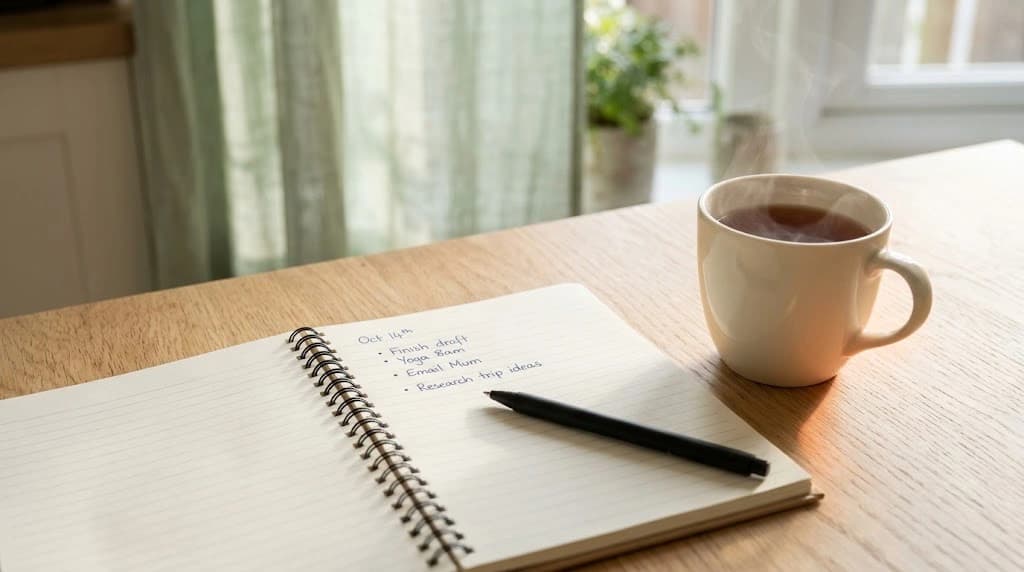
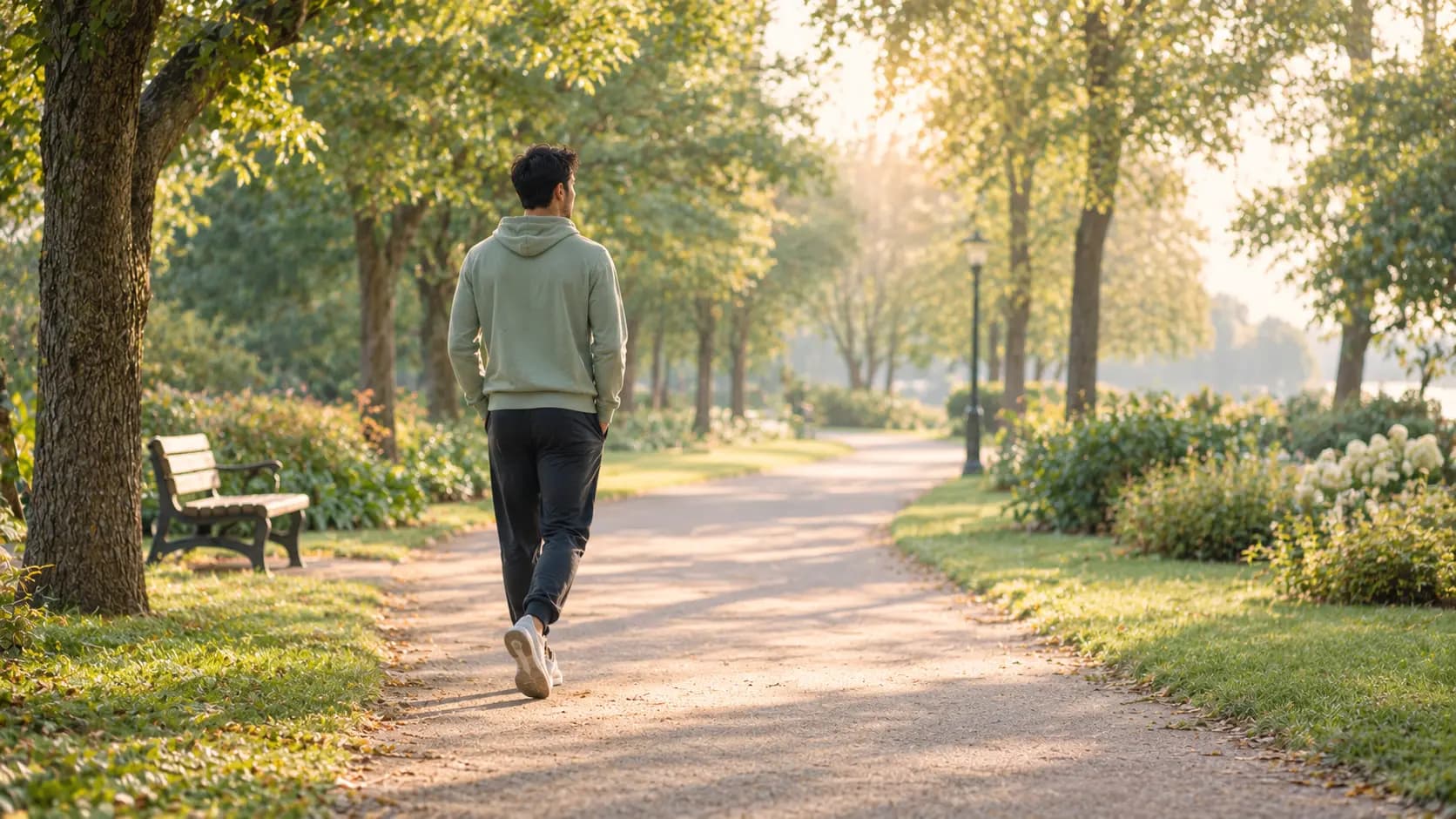
Some days your head is a browser with forty tabs open. You sit down to meditate, close your eyes, and spend ten minutes planning dinner. If that sounds familiar, mindful walking might suit you better than a cushion.
Mindful walking is exactly what it sounds like: walking while paying deliberate, friendly attention to the experience of walking. Your feet, your breath, the air on your skin, the sounds around you. It needs no kit, no quiet room and no special skill, just ten minutes and somewhere safe to step.
This guide explains what mindful walking is, how it differs from your usual exercise walk, and what you can realistically expect from it. You'll get a step-by-step 10-minute practice, a sensory guide, three variations, common mistakes, safety notes and a simple 7-day plan.
What Is Mindful Walking?
Mindful walking is a form of walking meditation. Instead of using the breath or a sound as the anchor for your attention, you use the physical act of walking. You move slowly, notice what is happening in your body and surroundings, and when your mind runs off (it will), you bring it back without scolding yourself.
The idea is old. Many Buddhist traditions teach walking meditation alongside sitting practice, often on a short, slow path. There is nothing mystical about it: you are training one skill, noticing where your attention is and steering it back, kindly.
How Is It Different From Exercise Walking?
Both involve putting one foot in front of the other, but the goal is different.
Mindful walking | Exercise walking | |
Main aim | Attention and calm | Fitness and health |
Pace | Slow to natural, comfortable | Brisk, steady or in intervals |
Where your mind goes | On the walk itself | Anywhere: music, podcasts, planning |
How you measure it | Moments of noticing | Minutes, steps, heart rate |
Distance | Barely matters | Often the point |
They are partners, not rivals. If you want the fitness side, a plan like Japanese walking for fitness walks uses brisk and easy intervals to build stamina. If you like a gentler pace, zone 2 easy pace training is a good match. Mindful walking is the quieter cousin: you can do it on its own, or as a ten-minute opener before one of those sessions.
What Are the Benefits? An Honest Look
You will see big claims online, so here is the grounded version.
Walking itself is good for you. Regular walking is linked with better heart health, better mood and lower stress, and it is one of the easiest ways to stay active. Meditation-style practices also help many people feel calmer.
Mindful walking on its own is less well studied, so it is hard to say how much of the calm comes from the mindfulness, how much from the walking, and how much from simply taking a break outdoors. Either way, it is a helpful habit alongside other healthy ones, not a cure-all.
So here is a fair summary of what you might notice:
Attention. Practising returning to the present moment may make it easier to notice when you have drifted off. The effect is usually small, but it builds with practice.
Mood. A calmer, slightly lighter feeling after a walk is common. Time in green space seems to add to this.
Stress. Slowing down and breathing steadily gives your nervous system a chance to settle. Many people report feeling less wound up afterwards.
It will not fix anxiety or burnout on its own. Think of it as one small, free tool.
Your 10-Minute Mindful Walking Practice
Choose a quiet path of 10 to 20 steps, or a loop through a park or garden. Put your phone on silent and set a gentle timer.
1. Arrive (1 minute)
Stand still. Let your arms hang loosely and soften your knees. Feel your weight through both feet. Take three slow breaths, and let your shoulders drop on each out-breath. Tell yourself, simply, "I'm here for ten minutes."
2. Feel your feet (2 minutes)
Begin walking slower than normal. Notice the heel touching down, the foot rolling forward, the toes pushing off, the other foot lifting. You don't need to exaggerate the movement. Just feel it. Some people silently label the steps: "lifting, moving, placing."
3. Add the breath (2 minutes)
Without changing how you breathe, notice it as you walk. It may match your steps, or not. Either is fine. Keep a little attention on your feet and a little on your breath.
4. Open the senses: 5-4-3-2-1 (3 minutes)
Now widen your attention to the world around you. Slowly, at walking pace, notice:
5 things you can see. Notice colour, shape, movement.
4 things you can feel. Air on your face, clothes on your arms, the ground under your soles.
3 things you can hear. Near, far, and the quiet beneath them.
2 things you can smell. Cut grass, rain, coffee. If nothing, that counts.
1 thing you can taste. Often just the inside of your mouth, and that's fine.
5. Handle the wandering mind (woven through)
Your mind will wander, often within thirty seconds. That is not failure, it is the exercise. The moment you notice you've drifted, that is the moment of mindfulness. Silently say "thinking," return to your feet, and carry on. If your thoughts keep looping, the tips in our guide on how to stop overthinking pair well with this practice.
6. Finish (2 minutes)
Stop walking. Stand still and notice how your body feels compared with when you began. Take one slow breath. Look up and out at the furthest thing you can see. Then carry on with your day, trying to keep a little of that attention for your next few steps.
A Sensory Guide to Use as You Walk
When you are not sure what to notice, use this table as a menu. Pick one row per walk if that is all you can manage.
Sense | What to notice | Gentle prompt |
Touch | Soles on the ground, air temperature, arm swing, clothing | "How does the ground feel today?" |
Sound | Footsteps, birds, traffic, wind, distant voices | "What is the furthest sound?" |
Sight | Light and shadow, colours, textures, movement | "What have I never noticed here?" |
Smell | Earth, plants, rain, food, fresh air | "What does the air carry?" |
Body | Posture, jaw, shoulders, balance, breath | "Where am I holding tension?" |
Three Ways to Vary Your Practice
Indoor hallway
Walk 8 to 12 steps in a straight line, pause, turn slowly and walk back. Turning is part of the practice: notice your weight shift.
On your commute
You can't go slowly on a busy street, so instead of slowing down, narrow your focus. Choose one stretch, say from the door to the corner, and give it your full attention: footsteps, breathing, sounds. Leave headphones out for that stretch. If you want to make your whole walk a break from your screen, the ideas in a phone-free walk can help you resist the pull of your pocket.
Forest or park: nature walking
Green space adds gentle things to notice: leaf textures, birdsong, shifting light. Walk slowly, pause when something catches you, and let your eyes soften to take in the wider view. If you enjoy combining movement with stretching, try adding a few moves from a walking yoga routine at the end.
Tips for Beginners
Start with five minutes if ten feels long. A short practice done often beats a long one done once.
Go slower than feels natural, but not so slow that you feel unsteady.
Expect an itchy mind. Noticing it is the practice.
If Sitting Meditation Is Hard for You
Plenty of people struggle to sit still. Walking gives your body a job, which often calms the urge to fidget. It is a legitimate practice in its own right, not a lesser version of sitting.
You can also use the two together. Try a short walk, then sit for a few minutes afterwards, as many traditions do. If you would like to try the seated version, our 5-minute meditation for beginners is a gentle place to start.
Common Mistakes to Avoid
1. Treating it as exercise. You are not trying to burn calories or hit a step count.
2. Judging your focus. "I was terrible, I kept thinking" misses the point. Noticing is the win.
3. Staring at your feet. It's tiring and unsafe outdoors. Keep your head level.
4. Walking too slowly. If you feel wobbly or self-conscious, speed up a little.
5. Checking your phone. Silence it first.
6. Quitting after a scattered walk. Some will feel like that. It's normal.
Safety Notes
Traffic. Never practise slowly near roads, cycle lanes or in car parks. Choose a quiet path, garden or indoor space, and keep your eyes open and aware.
Balance. Slow walking asks more of your balance than normal walking. Wear flat, stable shoes, avoid wet or uneven ground, and stay near a wall or rail if you are unsteady.
Dizziness. If you feel light-headed, stop, stand or sit, and breathe normally. Slow breathing should be gentle, never forced or held.
Health conditions. If you have balance problems, heart or lung conditions, or you are recovering from an injury, check with your doctor first. If you can't walk comfortably, a seated body-and-breath practice can offer similar benefits.
A Simple 7-Day Plan
Day | Practice | Time |
1 | Arrive and feel your feet only | 5 minutes |
2 | Feet and breath | 5 minutes |
3 | Full 10-minute practice indoors | 10 minutes |
4 | Sounds only, outdoors on a quiet path | 10 minutes |
5 | Full practice with 5-4-3-2-1 | 10 minutes |
6 | Nature walk, slow and unhurried | 10 minutes |
7 | Free choice, then note what you noticed | 10 minutes |
On day 7, jot down one line about how you feel compared with day 1. Missed a day? Just start again.
Frequently Asked Questions
What is mindful walking?
Mindful walking is a type of walking meditation in which you pay open, non-judging attention to the experience of walking, including your steps, breath, senses and thoughts.
How long should I practise mindful walking?
Ten minutes is a good target, and five is a fine start. Regular short sessions are generally easier to keep up than occasional long ones.
Can mindful walking help with anxiety or stress?
It may help you feel calmer and more grounded. But it is not a substitute for professional care if anxiety is affecting your daily life.
Is it safe to do outdoors?
Yes, on quiet, even paths away from traffic. Stay aware of your surroundings, and keep your eyes open and your head up.
Mindful walking is a simple, free way to give a busy mind somewhere gentle to land. It will not replace exercise, therapy or sleep. But ten minutes of slow, curious steps is low risk, easy to start and, for many people, quietly restorative. Try the 7-day plan, keep your expectations modest, and see how you feel.
This article is general information, not medical advice. If you have a health condition, balance problems or ongoing anxiety or low mood, please speak to your doctor before starting a new practice.