
You get into bed, the lights go off, and suddenly your brain decides it is the perfect time to replay an awkward email, tomorrow's to-do list and every worst-case scenario you can think of. If that sounds familiar, you are not alone. Anxiety at night is one of the most common reasons people lie awake.
The frustrating part is that you may have felt fine all day. Then the house goes quiet and your mind gets loud. It can feel like something is wrong with you, but there are clear reasons this happens, and most of them are ordinary.
In this guide you'll learn why anxious thoughts peak after dark, what is normal and what is not, and nine practical ways to calm down, including what to do when you wake at 3am. There is also a section on when to get help, and answers to common questions.
Why Anxiety Feels Worse at Night
There is rarely one cause. It is usually a stack of small ones that all arrive at bedtime.
Fewer distractions
During the day, work, messages and errands compete for your attention, which keeps worries in the background. At night that noise disappears. Lying in the dark with nothing to do, your mind fills the space with whatever is unresolved. Without the day's distractions, worries have more room to take over.
Tiredness lowers your emotional brakes
When you are tired, the part of your brain that helps you keep things in proportion works less well. A small problem feels bigger at 11pm than it does at 11am.
Stress hormones and body rhythms
Cortisol, often called the stress hormone, follows a daily rhythm. It is normally lowest in the evening. For some people, stress keeps the body on alert and makes it hard to settle. It is not clear how much this matters for everyday anxiety, so treat it as one piece of the puzzle.
Rumination and the sleep worry loop
Rumination means going over the same thoughts again and again without reaching an answer. At night it often turns into worry about sleep itself: "If I don't drop off soon, tomorrow will be a disaster." That pressure makes your body more alert, which makes sleep harder, which feeds the worry. If rumination follows you through the day too, our guide to how to stop overthinking is a useful companion.
Screens and the news
Scrolling in bed pours alarming or stimulating content into your head just before you want it to switch off. Bright screens can also delay the body's wind-down signals.
What Is Normal and What Is Not
Occasional anxious nights are a normal part of life. A big week at work, a family worry or a period of change can stir things up, and it usually settles once the stress passes.
It is worth paying closer attention if:
Night-time anxiety happens most nights for several weeks
It affects your mood, concentration or energy during the day
You are dreading bedtime
You wake with panic, a racing heart or breathlessness
You rely on alcohol to switch off
None of these means something is seriously wrong, and all of them are treatable.
9 Ways to Calm Down When Anxiety Hits at Night
These steps work best as a package. Try them for a couple of weeks before judging them.
1. Build a simple wind-down routine
Your brain needs a runway. Aim for 30 to 60 minutes of low-key activity before bed: dim the lights, put your phone out of reach, and do something quiet such as reading a paperback, gentle stretching or a warm shower. The pattern matters more than the activity. If your bedtime swings about from day to day, this is harder, so see our guide on how to fix your sleep schedule.
2. Set up a worry window earlier in the evening
Pick 15 to 20 minutes, ideally two or three hours before bed, as your official time for worrying. Write down everything on your mind. For each item ask: "Is there something I can do about this?" If yes, note the next small step. If no, write "can't control this" and let it be.
Then, when a worry pops up at bedtime, you can tell yourself it already has its own slot. The idea is borrowed from CBT techniques that therapists use widely.
3. Write it down before you get into bed
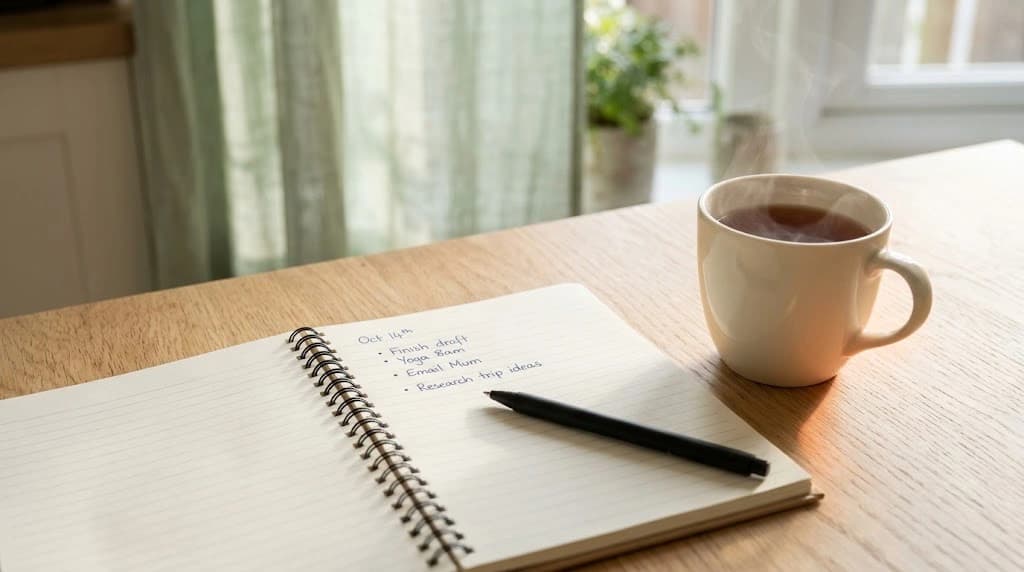
If your worries are mostly about tomorrow's tasks, a brain dump helps. Many people find that five minutes spent writing tomorrow's to-do list before bed makes it easier to fall asleep than going over what they have already done. Keep a notebook by the bed, and if a thought appears after the lights are out, jot a few words and let it go.
4. Slow your breathing
Slow breathing with a longer out-breath helps your body shift out of alert mode. Try breathing in through your nose for four and out slowly for six, for about five minutes. Our comparison of box breathing and 4-7-8 breathing will help you choose a pattern, and the free breathing timer paces each breath so you don't have to count. If holding your breath makes you more anxious, skip the holds.
5. Ground yourself with 5-4-3-2-1
When thoughts are spiralling, bring your attention to the room. Quietly notice:
5 things you can see
4 things you can feel (the duvet, the pillow, your feet)
3 things you can hear
2 things you can smell
1 thing you can taste
It takes about a minute. If your mind wanders back to worry, that is fine. Just start again.
6. Try a short meditation or body scan
Lying down, bring your attention to your toes, then your feet, then slowly up through your body, letting each part soften. If you are new to this, our 5-minute meditation for beginners is a gentle place to start. The aim is not to empty your mind, only to give it something calmer to rest on.
7. Keep your bed for sleep
If you scroll, work or watch box sets in bed, your brain starts to link the bed with being awake. Keep it for sleep, and stop any reading when you feel drowsy.
8. Make the bedroom cool, dark and quiet
Blackout curtains or an eye mask, a cooler room and a little white noise can all take pressure off. A cool, dark, quiet bedroom is one of the basic things that help you stay asleep.
9. Look after your days, too
Regular movement, morning daylight and regular meals all help. Some people also ask about supplements, and we have a separate look at magnesium for sleep that goes through what it can and can't do. Check with a pharmacist or doctor before starting anything, especially if you take medication.
What to Do If You Wake at 3am
Waking in the small hours feeling anxious is very common, and the clock makes it worse. Here is a calm plan:
1. Don't watch the clock. Turn it away. Counting the hours left only adds pressure.
2. Give it about 20 minutes. Use your breathing or grounding. If you are still wide awake after roughly 20 minutes, don't force it.
3. Get up. Go to another room and do something quiet in dim light, such as reading or folding laundry.
4. Avoid your phone. Bright light and a feed full of news will wake you further.
5. Go back when you feel sleepy. Not before. If it happens again, repeat.
This is a core part of CBT for insomnia, often called the 20-minute rule. It feels odd to leave a warm bed, but over a week or two it helps your brain relearn that bed means sleep.
What to Avoid
Caffeine late in the day. Try avoiding it from early afternoon, and cut it out if you are sensitive.
Alcohol as a sleep aid. A drink may make you drowsy, but it tends to fragment sleep later in the night. For many people, the glass of wine is the reason for the 3am wake-up.
Doomscrolling. Set a cut-off time and keep your phone out of the bedroom. Our tips to stop doomscrolling make this easier.
When to Speak to a GP or Therapist
Book an appointment if night-time anxiety is frequent, lasts more than a few weeks, or affects your daytime life. You don't need to wait until it feels severe. It helps to keep a sleep diary for a week or two beforehand, which lets your doctor see the pattern.
Two treatments are widely used:
Treatment | What it helps with | What it involves |
CBT for insomnia (CBT-I) | Trouble falling or staying asleep | Structured sessions, an app or a guided programme covering sleep habits and thoughts about sleep |
CBT for anxiety | Worry, panic and constant tension | Learning to spot and test anxious thinking and gradually face avoided situations |
CBT-I is widely used as a first treatment for ongoing insomnia, and many people find it works as well as sleeping tablets without the side effects. A GP can also check for other causes, such as thyroid problems, sleep apnoea or medication effects.
If you need to talk to someone now
If you feel overwhelmed, hopeless or are thinking about harming yourself, please reach out. In the UK and Ireland, Samaritans is open 24 hours a day on 116 123, free to call. In the US, you can call or text 988, the Suicide and Crisis Lifeline. If you are in immediate danger, call your local emergency number (999 in the UK, 911 in the US).
Frequently Asked Questions
Why is my anxiety worse at night?
Mostly because the day's distractions fall away, you are tired, and your mind has space to dwell on unresolved worries. Stress rhythms and worry about sleep can add to it.
Is anxiety at night normal?
Yes, occasional anxious nights are very common, especially in stressful periods. Get support if it happens most nights, lasts weeks or affects your daytime life.
What should I do if I wake at 3am with anxiety?
Don't check the clock. Try slow breathing or 5-4-3-2-1 grounding. If you are still awake after about 20 minutes, get up, sit somewhere dimly lit, do something calm, and return to bed when sleepy.
Does a worry window really work?
Many people find it helpful, and it is based on well-used CBT ideas. Treat it as a low-risk tool to try for a couple of weeks.
Anxiety at night is common, understandable and very often manageable. The dark, the quiet and a tired brain create ideal conditions for worry, so give your mind a plan: a steady wind-down, a worry window earlier in the evening, a notebook by the bed, slow breathing and grounding, and a clear routine for 3am.
Pick two or three steps to start with, and give them a couple of weeks. If things don't improve, that is not a failure. It means it is time to bring in a GP or therapist.
This article is for general information only and is not medical advice. If you have a health condition, or your anxiety or sleep problems persist, please speak to your doctor or a qualified professional.