
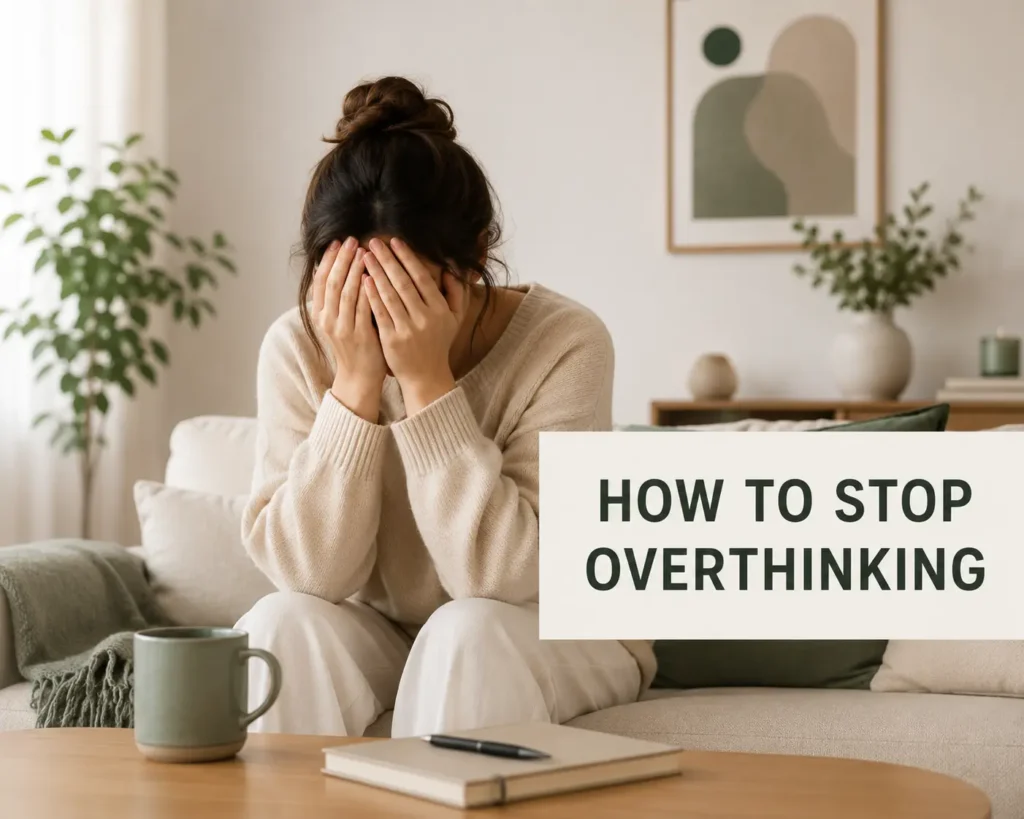
It’s midnight. You’re exhausted. And yet your brain acts like it just had three cups of coffee.
One small moment from the day keeps looping. Something you said. Something someone else said. Some thing that might go wrong next week that hasn’t even happened yet.
Sound familiar?
Yeah. Most of us have been there. It’s called overthinking, and honestly, it’s one of the most tiring things a mind can do to you.
A little bit here and there is normal. But when it becomes your default setting — every day, every night — it starts eating into your sleep, your mood, your focus, even the way you treat the people around you.
Here’s the part nobody really tells you, though: you can calm it down. Not with some magic trick, but with a handful of small habits you repeat until they stick. Let’s walk through them.
What Is Overthinking, Really?
Overthinking is when you chew on the same thought over and over… and still end up nowhere.
You’re not solving anything. You’re just circling. “What if this. But then that. But what about—” On and on it goes.
Quick example. You text a friend. Hours pass. No reply. And suddenly your brain writes a whole drama:
- “They’re annoyed with me.”
- “Did I say something weird?”
- “Maybe they’re just done with me.”
Meanwhile? Their phone was on silent in another room. That’s it. That’s the whole story.
So Why Do We Do It?
Lots of reasons, honestly.
Some people are just natural over-analyzers — their brain pokes at everything. Others got burned in the past, so now they brace for the worst before anything even happens. And if you lean a bit perfectionist, overthinking sneaks in because you want every choice to be just right before you move.
Add some stress, a rough day, a little low confidence, and a fear of messing up… and the loop only gets louder.
What It Actually Does to You
Overthinking isn’t just noise in your head. It wears you down.
You wake up tired even though you technically slept. Small jobs start to feel heavy. Concentrating? Good luck. And nighttime is the worst — you lie there for an hour, maybe three, replaying stuff on a loop.
The sneaky part is how it blows things out of proportion. A tiny worry gets fed and fed until it feels like a full-blown crisis. Nine times out of ten, it isn’t.
How to Stop Overthinking: 7 Habits That Actually Help
None of these are complicated. That’s kind of the point. Small stuff, done often, beats big stuff done once.
Don’t Trust Every Thought
Just because a thought pops up doesn’t make it true.
Your mind guesses a lot. And most of those guesses aren’t facts — they’re just fear wearing a costume.
So when a dark little thought shows up, pause and ask it one thing:
“Do I actually have proof for this, or am I just making it up?”
You’d be surprised how often the honest answer is, “yeah… I’m making it up.”
Deal With What’s Actually in Your Hands
You can’t control what people think of you. You can’t control tomorrow. You definitely can’t control how everything ends up.
But today? Your next move? That part is yours.
So when the spiral starts, drag your attention back to one small thing you can do right now. Just one.
Give Your Mind Something to Do
An empty, bored mind is basically a worry factory.
Go for a walk. Cook something. Text someone you like. Learn a random skill off YouTube. Get lost in a book or an old hobby.
It’s simple math — when your time is full of good stuff, there’s less room left for overthinking to move in.
Dump It Onto Paper
When your head feels too full, write it out. An old notebook, the notes app, whatever’s closest.
Don’t fix the spelling. Don’t make it pretty. Just spill it.
Something odd happens when a worry leaves your head and lands on a page, it shrinks. It stops feeling like this huge grey cloud and starts looking like, well, just a sentence. Usually a smaller one than you expected.
Let Go of “Perfect”
Here’s the truth: the perfect decision doesn’t exist. Waiting around for it just means waiting forever while life moves on without you.
A decent choice made today will always beat a perfect one that never shows up.
Say it with me — progress beats perfection. Every single time.
Put the Phone Down
Endless scrolling feeds overthinking more than you’d think.
Everyone online is showing their highlight reel — the trips, the wins, the good-hair days. And there you are, comparing your regular Tuesday to someone else’s best moment. Not exactly a fair fight.
So take breaks. Real ones. Your head gets a lot quieter without that constant background noise.
Trust Allah and Let It Go
Islam gives us such a beautiful balance: do your best, then hand the rest over to Allah.
Sitting there worrying about a future you can’t even see only wears your heart out.
So pray. Make dua. And trust that Allah’s plan is better than anything you could stitch together in your head at 2 a.m. That trust brings a peace no amount of overthinking will ever come close to.
When It’s Time to Reach Out
Sometimes it’s more than just a habit.
If overthinking is wrecking your sleep, your work, your studies, or your relationships — or if the anxiety just feels too heavy to carry alone — please talk to a proper mental health professional.
That’s not weakness. That’s you being smart and kind to yourself. Big difference.
Final Thoughts
Overthinking is a habit. And habits — every single one of them — can change. It just takes a bit of time and a lot of small tries.
You don’t owe your attention to every thought that barges in. Spend it on what you can actually control, and take one small, positive step each day.
Life isn’t meant to be spent stuck in your head, thinking about living.
It’s meant to be lived. And the more you actually do, the quieter that overthinking voice gets.