Gratitude journaling sounds almost too simple to bother with. You write down a few good things, close the notebook, and carry on with your day. No app, no subscription, no special kit.
That simplicity is exactly why so many people start and then quietly stop after a week. The first few entries feel nice. Then you run out of ideas, or you start writing "my family, my health, my job" every night and wonder what the point is.
This guide is for anyone starting gratitude journaling from scratch. You will get a five-minute method you can finish before your tea goes cold, prompts for the days your mind goes blank, and honest advice for when the whole thing feels forced.
What Gratitude Journaling Actually Is
Gratitude journaling is the habit of writing down things you appreciate, usually once a day or a few times a week. That is all it is. It is not forced positivity, and it does not ask you to pretend that everything is fine.
The idea is to train your attention. Most of us are quick to notice what is wrong, late, or unfinished. Writing a few specific good things gives your mind a small counterweight. Many people find that over a few weeks they start noticing nice moments as they happen, because part of them is already thinking "that could go in the notebook".
It also helps to know what it is not. It is not a replacement for professional support if you are struggling, and it will not fix a hard situation. Think of it as a gentle daily habit, closer to stretching than to medicine.
What You Need to Start
Almost nothing. Pick one of these and move on:
- A cheap notebook you keep by the bed or on the kitchen table
- The notes app on your phone, if you always have it with you
- A stack of sticky notes that you drop in a jar, handy if you dislike blank pages
Choose whatever is easiest to reach. A beautiful journal can feel precious, and then every entry feels like it has to be impressive. A scruffy notebook has no such pressure.
The 5-Minute Gratitude Journaling Method
This is the simplest routine that tends to stick. Set a timer for five minutes if that helps you stay loose about it.
- Take one slow breath. Just one. It marks the moment as separate from scrolling or rushing about.
- Write the date. It gives you something to do before the hard part.
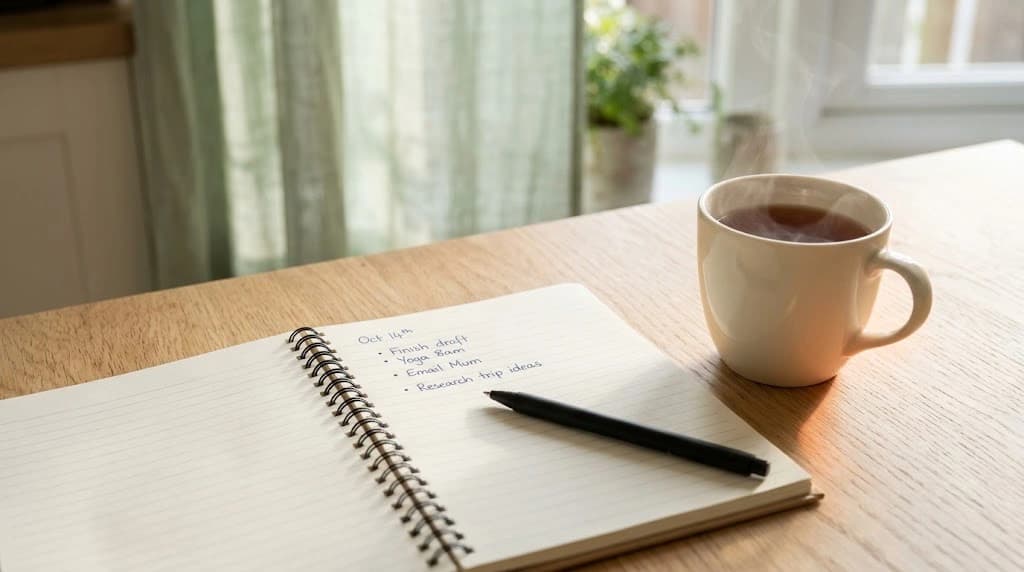
- List three things from today. They can be tiny: the first sip of coffee, a stranger holding a door, a song on the radio.
- Add one line of "why" to your favourite. For example, "The neighbour waved from her window, and it made the street feel friendlier."
- Stop. Do not edit, judge or add a fourth item because you feel you should.
The "why" line is the part that does the most work. Writing "my sister" is a label. Writing "my sister sent a silly photo at lunchtime and I laughed on a rough day" is a memory, and memories are what make the habit feel real.
Keep It Specific
Vague entries wear out quickly. "I'm grateful for my health" is fine on day one and flat by day ten. Specific entries stay fresh because every day is different. Compare these:
| Vague | Specific |
|---|---|
| My home | The way the afternoon light hit the kitchen table |
| My friends | A friend who remembered I had a dentist appointment and texted to ask how it went |
| My job | A colleague who explained the new system without making me feel slow |
| Food | The soup I made on Sunday still tasting good on Tuesday |
Pick a Time You Will Actually Use
Morning works for some people, because it sets a tone for the day. Evening works for others, because there is a whole day to look back on. Neither is better. The best time is the one you already have a habit for. If you struggle to remember, try attaching it to something you do anyway, which is the idea behind our habit stacking guide. Write your three things right after you pour your first cup of tea, or right after you brush your teeth at night.
Gratitude Journal Prompts for Beginners
When your mind goes blank, a prompt gives it somewhere to start. You do not need to answer all of them. Pick one and see where it goes.
Easy Everyday Prompts
- What is one small thing that went better than I expected today?
- Which meal, drink or snack did I enjoy most?
- Who made my day a little easier, even slightly?
- What is something in my home that I would miss if it were gone?
- What did I see, hear or smell today that I liked?
Prompts for People
- Who has been kind to me this week, and how?
- Who could I thank today, even with a short message?
- Which friend makes me laugh, and what did they do last?
- Who taught me something I still use?
Prompts for Harder Days
- What is one thing that is still going okay, even though today was difficult?
- What helped me get through this afternoon?
- What is something I can do now that I could not do a year ago?
- What small comfort is available to me tonight?
Prompts to Look Forward
- What is one thing I am looking forward to this week?
- What would make tomorrow feel good, even a little?
- What do I hope I will thank myself for later?
What to Do When Gratitude Journaling Feels Forced
Nearly everyone hits this wall. You sit down, stare at the page, and feel nothing. Or worse, you feel a flicker of irritation, because you are not grateful, you are tired. That is normal and it does not mean you are doing it wrong.
Here is what tends to help.
Lower the Bar
Write one thing, not three. Or write one word. A tiny entry that you actually make beats a perfect entry you skip. Once the habit is steady you can stretch it again.
Start With Neutral, Not Joyful
You do not have to feel overflowing thankfulness. Try "noticing" instead. "My bed is warm." "The bus was on time." "The rain stopped before I walked home." These are small, true and easy to write. Warmth often follows noticing, but it does not need to arrive first.
Be Honest About Bad Days
If today was awful, say so, then add one line of what held you up. "Terrible day, but the cat sat on my lap for ten minutes." Honest entries feel much less fake than cheerful ones you do not believe. If your mind keeps looping on what went wrong, our guide on how to stop overthinking has gentle ways to quiet the spinning before you pick up your pen.
Change the Format
If a list feels dull, switch it up for a few days:
- Write a two-line thank-you note you never send
- Take one photo of something you like and add a caption
- Draw a quick doodle of your day
- Say your three things out loud to a partner or friend at dinner
Skip a Day Without Guilt
Missing a day is not failure. The only real mistake is deciding that one missed day cancels the whole habit. Pick the notebook up again tomorrow and carry on, as if nothing happened. Because nothing did.
Common Mistakes to Avoid
- Doing too much too soon. Fifteen minutes every day is a lot. Five is plenty.
- Writing the same list every day. If every entry matches the last, challenge yourself to find one new thing.
- Using it to dismiss real problems. Gratitude can sit beside frustration. You can be thankful for a friend and still be upset about a bad week.
Making It Part of Your Week
A simple weekly rhythm can keep things interesting without becoming a chore:
| Day | Focus |
|---|---|
| Monday | Three small things from today |
| Tuesday | One person you appreciate and why |
| Wednesday | Something in your body or health that worked well |
| Thursday | A place or moment in nature, even a patch of sky |
| Friday | One win from the week, however small |
| Weekend | Read back over earlier entries |
That last step is underrated. Looking back through a few weeks of entries is often the moment people realise how many good moments they would have forgotten.
Pair It With Other Calm Habits
Gratitude journaling sits nicely beside other quiet routines. If you like the idea of settling your mind first, a short session from our 5-minute meditation for beginners guide makes a good warm-up before you write. If you are journaling in the evening, a steady bedtime helps too, and our tips on how to fix your sleep schedule can help you protect that wind-down time.
And if you ever feel flat and unmotivated, a short, easy list of small pleasures can help you choose something enjoyable for the day. Our dopamine menu is a handy place to start, and you can turn whatever you pick into tonight's journal entry.
Frequently Asked Questions
How long should I do gratitude journaling each day?
Five minutes is plenty. Many people find that two or three short entries a day are enough, and a few minutes of steady practice beats a long session you dread.
What should I write if I cannot think of anything?
Start with the senses. What did you taste, hear, see or feel today that was pleasant? A warm drink, clean sheets and a quiet moment all count. Or pick one prompt from the lists above and answer it in a single sentence.
Is it better to journal in the morning or at night?
Either works. Morning entries can set a positive tone, while evening entries let you reflect on the day. Choose the time you are most likely to keep, then stick with it for a couple of weeks before deciding.
Does gratitude journaling work if I am feeling low?
It can be a gentle support for some people, but it is not a treatment. On low days, keep entries honest and small. If low mood lasts for weeks, affects your sleep or appetite, or makes daily life hard, please speak to a doctor or a mental health professional.
How often should I write in my gratitude journal?
Daily is simple to remember, but three or four times a week is fine for many people. A lighter routine you keep is better than a daily one you drop after a fortnight.
The Bottom Line
Gratitude journaling does not need to be deep, poetic or even particularly cheerful. It needs a few quiet minutes, a notebook and a willingness to notice what is already going okay. Start with three small things, add one line about why, and stop.
When it feels forced, shrink it, be honest and try a new format. Most people who make it past the first awkward fortnight find that it becomes less of a task and more of a small pause they look forward to. Try it for two weeks, keep it light, and see how your days feel.
This article is general information only and is not medical advice. If you have a health condition or are struggling with your mood, please speak to a doctor or qualified professional.