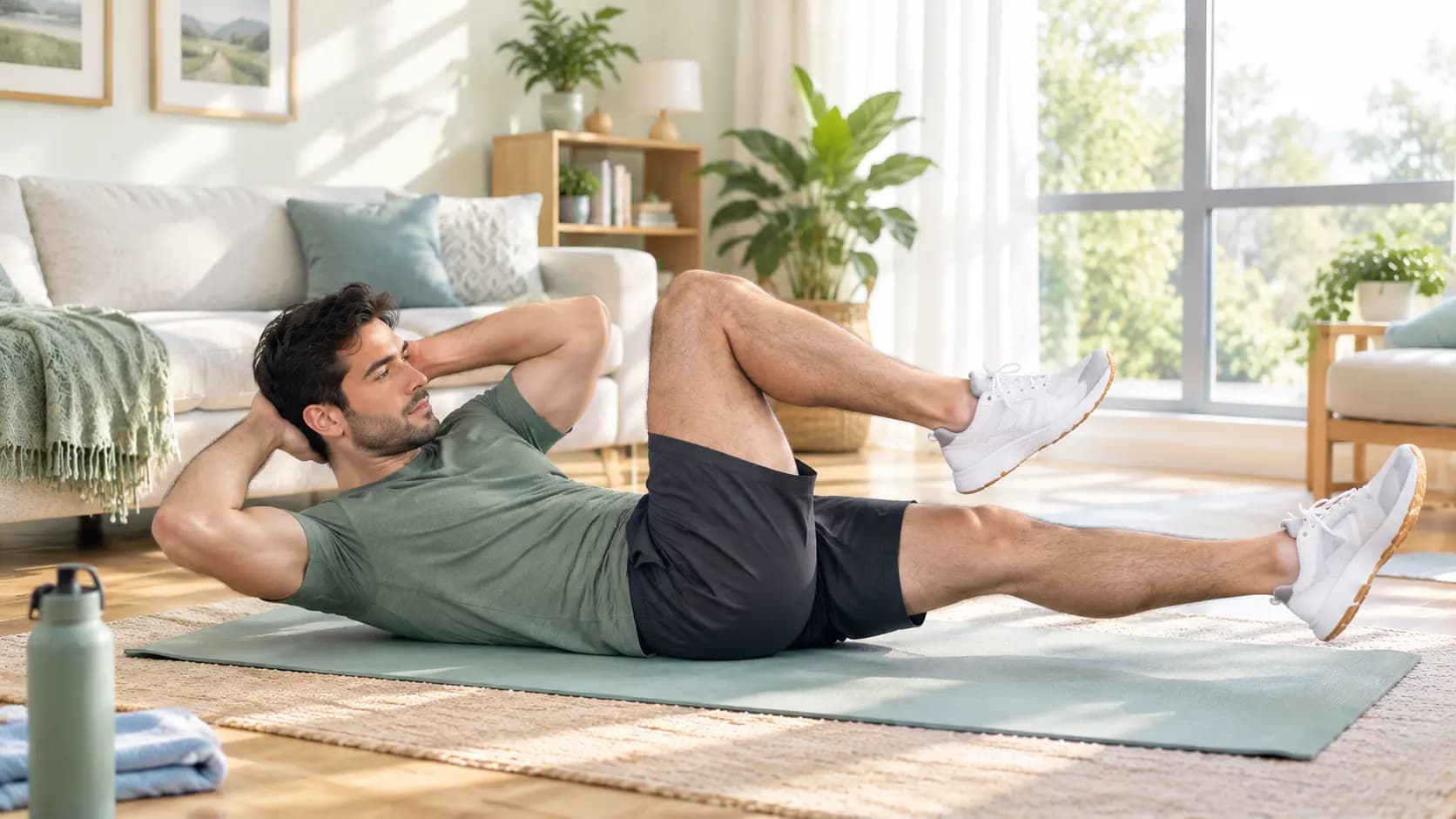
If you have been seeing Pilates everywhere lately, you are not imagining it. It is one of the most searched fitness topics right now, and for good reason: Pilates at home needs a mat, a bit of floor space and about twenty minutes. No studio membership, no machines.
The movements are slow, controlled and easy to scale down. If you can lie on the floor and get back up again, you can start.
This guide explains what Pilates is, what it can and can't do, and what you need to begin. You will get ten beginner mat moves with clear cues, a 20-minute routine, a simple four-week plan, breathing tips, common mistakes and a list of people who should check with a doctor first.
What Is Pilates, and Who Is It For?
Pilates is a system of low-impact exercise created by Joseph Pilates in the early 20th century. It focuses on the muscles around your trunk (often called the "core"), plus your hips, shoulders and back, and it asks you to move slowly with your breath and good control.
Most classes fall into two types:
Mat Pilates: done on the floor, using your own bodyweight. This is what you can do at home.
Reformer Pilates: done on a sliding machine with springs, usually in a studio.
Pilates tends to suit:
Beginners who want a gentle way into exercise
Desk workers who feel stiff by the evening
Older adults looking for balance and stability work (with a check-in if you have health conditions)
What Can Pilates Realistically Do?
Pilates has plenty of fans, so it helps to keep your expectations grounded.
What many people notice: After several weeks of regular practice, many people feel stronger through the middle, a little more flexible and steadier on their feet. Because Pilates trains you to notice alignment, you may feel you stand and sit taller, though that fades if you slump for eight hours a day.
Where the claims get loud: Back pain is where Pilates is often praised. Many people find gentle, controlled movement eases stiffness, and it can be a sensible option if you enjoy it. But it is not a cure, and it is not clearly better than other kinds of gentle exercise.
What it is not: Pilates is not a weight loss method. It burns fewer calories than brisk walking or running, and spot toning your tummy is not a thing. If fat loss is your goal, your overall activity and eating habits matter far more.
Mat vs Reformer: Which Should You Choose?
Mat Pilates | Reformer Pilates | |
Cost | Very low | Higher (studio classes) |
Equipment | Mat, optional props | Reformer machine |
Resistance | Your bodyweight | Adjustable springs |
Instruction | Video or app at home | Usually a live teacher |
Good for | Starting out, home routines | Extra support and variety |
A reformer adds spring resistance and usually a teacher who can correct your form. Mat work is cheaper and perfectly good for beginners. Start there, and try a reformer class later if you love it.
What You Need for Pilates at Home
Keep it simple:
A mat: thicker than a standard yoga mat if you can manage it (around 6 to 10 mm), so your spine and hips are comfortable when you lie down.
Comfortable clothes and bare feet or grippy socks.
Optional props: a folded towel for under your head.
To make it stick, habit stacking works nicely here: roll out the mat straight after brushing your teeth or right after your morning coffee.
Breathing Cues That Make Pilates Work
Breathing is what separates Pilates from simply doing floor exercises. Many teachers use side breathing: breathe in through your nose and widen your ribs sideways, then breathe out through pursed lips as your belly gently draws in.
Breathe in to prepare and to lengthen.
Breathe out on the effort, such as lifting a leg or curling up.
Do not hold your breath.
If you are new to paying attention to your breath, the habits in this guide to 5-minute meditation for beginners are a useful warm-up for the focus that Pilates asks for.
10 Beginner Pilates Moves for Your Mat
Move slowly, keep your neck relaxed and stop if anything hurts.
1. Pelvic Tilts
Lie on your back with knees bent and feet flat, hip-width apart. Breathe in, then breathe out and gently flatten your lower back toward the mat by tilting your pelvis. Breathe in and return to neutral. Do 8 to 10.
2. The Hundred (Beginner Version)
Lie on your back with knees bent over your hips (a "tabletop" position) or feet on the floor. Lift your head and shoulders slightly, and pump your arms by your sides in small, quick movements. Breathe in for five pumps and out for five. Aim for 5 to 10 breaths in total at first, not the full hundred.
3. Roll Up (Assisted)
Lie flat with your legs long or knees bent, arms overhead. As you breathe out, bring your arms up, nod your chin and peel your spine off the mat one bone at a time. Reach toward your feet, then roll back slowly. Keep your knees bent if it is too hard. Do 5 to 6.
4. Single-Leg Stretch
From tabletop, lift your head and shoulders. Draw one knee in, hand on the knee, other leg extended at an angle you can control. Switch legs smoothly. Breathe steadily. Do 6 to 8 on each side.
5. Glute Bridge
Lie on your back, feet flat and hip-width apart. Breathe out and lift your hips by peeling the spine up from the tailbone, so you form a diagonal line from shoulders to knees. Breathe in at the top, then roll back down slowly. Do 8 to 10.
6. Side-Lying Leg Lifts
Lie on your side with your body in one line and your bottom arm supporting your head. Keep your top leg at hip height, flexed gently, and lift and lower it without rocking your pelvis. Do 10 on each side.
7. Bird Dog
Start on hands and knees, hands under shoulders and knees under hips. Reach your right arm forward and left leg back while keeping your hips level, as if balancing a cup of tea on your lower back. Return and switch sides. Do 6 to 8 each side.
8. Dead Bug
Lie on your back with arms toward the ceiling and knees over your hips. Keep your lower back steady while you lower the opposite arm and leg toward the floor, then return. Alternate sides. Do 6 to 8 each side.
9. Forearm Plank
Place your forearms on the mat with elbows under shoulders, knees down to begin. Lengthen from head to knees, hold your tummy gently in, and breathe. Build up to 15 to 30 seconds, then progress to straight legs when you can hold good form.
10. Child's Pose
Sit back onto your heels with arms long in front of you and forehead resting down. Take 5 slow breaths and let your back widen with each one.
A 20-Minute Beginner Pilates Routine
Use this as your starting template. Rest for 20 to 30 seconds between moves, and move at your own pace.
Minutes | Move | Reps or time |
0 to 2 | Pelvic tilts | 10 slow reps |
2 to 4 | The Hundred (beginner) | 5 to 10 breaths |
4 to 6 | Roll up (assisted) | 5 reps |
6 to 8 | Single-leg stretch | 6 each side |
8 to 10 | Glute bridge | 10 reps |
10 to 12 | Side-lying leg lifts | 10 each side |
12 to 14 | Bird dog | 6 each side |
14 to 16 | Dead bug | 6 each side |
16 to 18 | Forearm plank | 2 rounds of 15 to 20 sec |
18 to 20 | Child's pose | 5 slow breaths |
A Simple 4-Week Plan
You do not need to do Pilates every day. Three sessions a week is a realistic start, and the other days can be lighter movement.
Week 1: Do the routine 2 to 3 times, using the easiest versions. Focus on breathing and form, not on how many reps you complete.
Week 2: Do it 3 times. Add 1 or 2 reps to each move and hold the plank a little longer.
Week 3: Do it 3 times. Try tabletop for the Hundred and bend only one knee on the roll up, if that feels comfortable.
Week 4: Do it 3 times, or try a longer 30-minute video class.
On other days, if you want some cardio, Japanese walking gives you short intervals that fit neatly around your mat sessions. For a gentle mobility mix, you could also try this walking yoga routine on a lighter day.
For measurable strength, add some resistance work. Our guide to strength training at home pairs well with a Pilates habit, and enough protein each day helps your muscles recover between sessions.
Common Mistakes to Avoid
1. Rushing. Pilates is about control. A slow, small move done well beats a fast, big one.
2. Holding your breath. It makes you tense and cuts the benefit.
3. Pulling on your neck. If it aches during curl-ups, rest your head down.
4. Letting your back arch. In moves like dead bug and the Hundred, shorten the lever by keeping knees bent.
5. Gripping with your tummy. Aim for gentle engagement, not sucking in hard.
6. Skipping rest days. Muscles adapt when they recover.
When to Check With a Doctor First
Pilates is generally considered low risk, but speak to a doctor or physiotherapist before you start if you:
Are pregnant (some positions will need to change)
Are recovering from a back or neck injury, surgery or a recent abdominal procedure
Have osteoporosis or low bone density (forward bending and rolling moves are often adapted)
Have a disc problem, severe pain, or numbness in your legs
Stop and seek advice if you feel sharp pain, dizziness or chest pain.
Frequently Asked Questions
How often should beginners do Pilates at home?
Two to three sessions a week of 15 to 20 minutes is a good start. Consistency matters more than length.
Can I learn Pilates at home without an instructor?
Yes, many people do. Begin with beginner-friendly videos, go slowly, and consider a single live class (online or in person) if you want feedback on your form.
Will Pilates help me lose weight?
Not on its own. It burns fewer calories than brisk walking, so treat it as a strength, control and mobility practice and pair it with other activity if weight loss is a goal.
Is Pilates good for back pain?
Many people find gentle, controlled movement helps with stiffness, but it is not a cure and it is not clearly better than other kinds of exercise. If you have ongoing back pain, talk to a healthcare professional first.
How long until I see results?
Many people feel more body awareness within a couple of weeks. Strength, flexibility and balance changes usually take several weeks of regular practice.
Pilates at home is a calm, low-cost way to build control, flexibility and a steadier centre. It will not melt fat or cure a bad back, but it can make everyday movement feel better. Start with the ten moves above, do the 20-minute routine three times a week, and let the habit grow from there.
This article is general information, not medical advice. If you have a health condition, are pregnant or have an injury, speak to your doctor or physiotherapist before starting a new exercise programme.